Public Domain Fish Art Painting Pinterest Utagawa Kuniyoshi Dragon
1000atsushika Hokusai is oft credited as the virtually famous Japanese artist in the world. His prints were sought afterwards throughout his life until this very day. Without Hokusai'southward daring imagination and dedicated piece of work ethic, we may never have received some of the greatest masterpieces of modern art.
Table of Contents
- 1 Erstwhile Master Hokusai
- 1.one A Katsushika Hokusai Biography
- i.2 Manga
- 2 Katsushika Hokusai's Painting Style
- 2.ane Perspective
- ii.ii Prussian Bluish
- 3 Hokusai Artworks
- 3.ane Thirty-Half-dozen Views of Mount Fuji (c. 1829–1832)
- 4 Mod Art
- 5 "The Sometime Human Crazy to Paint"
- six Frequently Asked Questions
- half dozen.1 How Many Prints Are in Thirty-Half dozen Views of Mount Fuji?
- 6.2 Was Hokusai Also a Operation Artist?
- 6.three Did Hokusai Work Lonely?
- half dozen.4 Did Hokusai Make Erotica?
- 6.5 Can You Tell How Many Blocks Were Used by Looking at a Hokusai Print?
Former Master Hokusai
Katsushika Hokusai'southward woodblock print The Smashing Wave of Kanagawa (1830) hugely impacted both pop culture and fine art history. His artistic endeavors included volume illustration and painting. In the times of the infamous Edo Catamenia, Hokusai produced an estimated 30 000 artworks. His ukiyo-e prints delivered a depiction of the globe which was a boldly abstracted blend of Western and Japanese art.
| Date of Birth | 31 October 1760 |
| Date of Death | 10 May 1849 |
| Place of Birth | Edo, Japan |
| Associated Art Movements | Edo menstruum, Ukiyo-e |
| Genre / Fashion | Cartoon, Painting, Printmaking Woodcut |
| Mediums Used | Woodcut |
| Dominant Themes | Metropolis scenes, Nature, mythology, sociology, working people, erotica |
A Katsushika Hokusai Biography
Katsushika Hokusai whose childhood name was Tokitarō was born in 1760 virtually 300 years ago. In the eye of the 18th century, Japan's then capital Edo, which is now called Tokyo, was in the throes of the Edo Period. He lived most of his life in a central part of town on the east bank of the Simiyula River. His birth family unit had lived in the working-class districts of Edo simply he was adopted by his uncle Nakajima Ise who was the official mirror-maker to the shōgun.
At the fourth dimension, the adoption of male children was a common strategy for strengthening i's lineage and social standing.
His close proximity to the imperial court afforded Hokusai an fantabulous education and he was well placed for a career in the arts. As a kid, he adult an interest in drawing. By the age of six, he was already using watercolor.
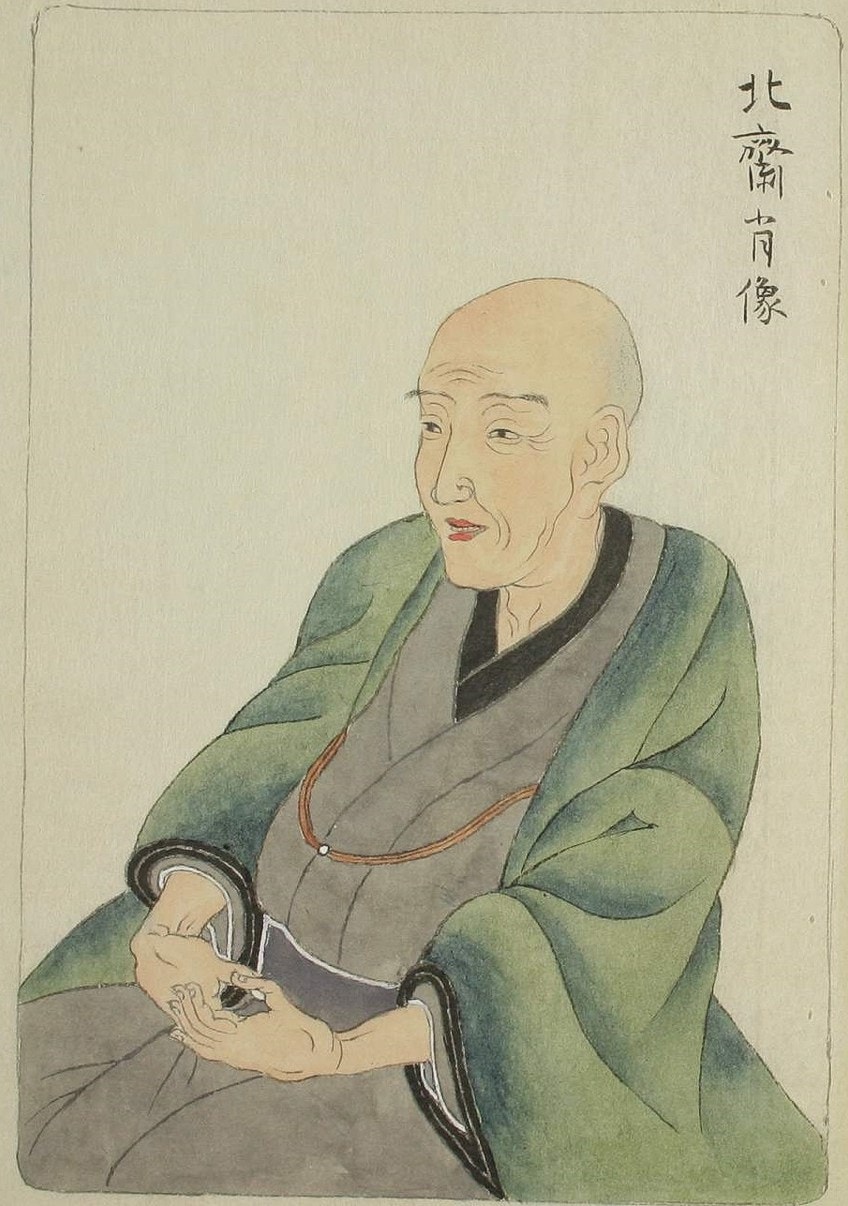 Portrait of Katsushika Hokusai by Keisai Eisen, before 1848;Keisai Eisen, Public domain, via Wikimedia Commons
Hokusai learned to pigment decorative mirror frames with the expectation that he would eventually bring together the family unit business. Equally a teenager, he became an apprentice to an engraver at which point he decided he wanted to be an creative person. Simply his artistic endeavors continued to reflect his interest in mirrors, microscopes, and telescopes.
Hokusai was raised every bit a Buddhist, which made divinity incredibly of import to him. Afterwards in life, he christened himself Hokusai in award of the goddess Myoken which means Due north Star. The sole stationary calorie-free in the heavens which the artist saw every bit a source for spiritual strength. One of his early works was an offering for Myoken'due south temple.
Despite his successful professional person life, Hokusai'south midlife brought on a long series of unfortunate events.
His first wife, with whom he had 3 children, died in the 1790s. Lightning literally struck him when he was 50. Then he suffered a small stroke which meant he had to relearn his creative skill. He remarried and had three more children just in 1828 his second wife also died. 2 of his children likewise predeceased him. And then was forced to use his life savings to pay off his grandson's gambling debts.
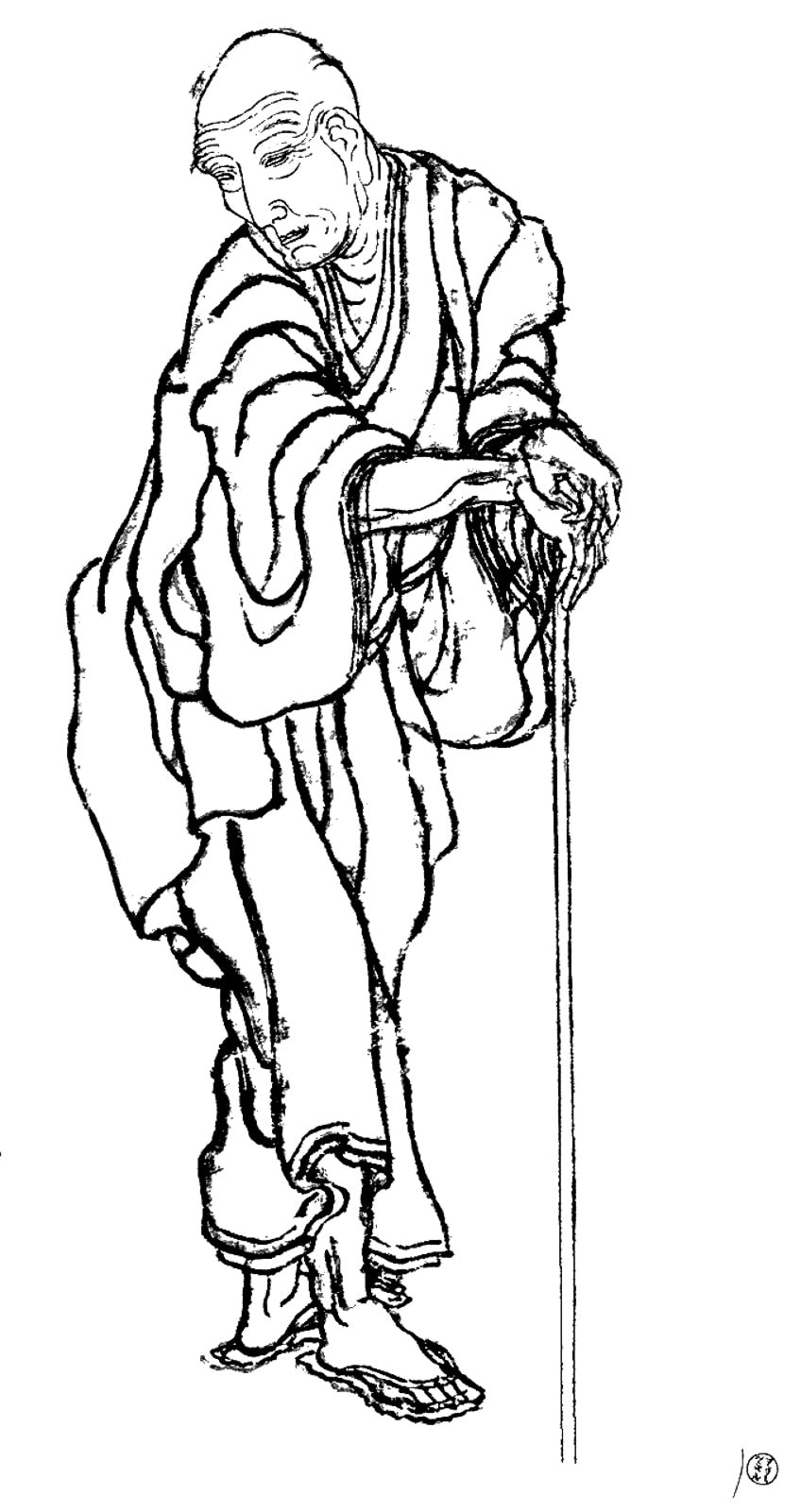 Self-portrait equally an old man (1839) past Katsushika Hokusai; Katsushika Hokusai, Public domain, via Wikimedia Commons
Eventually, Hokusai lost his home and had to move into a temple. He lived in that location for many years with his daughter who was also an artist. But in 1839, their lodgings were burned in a neighborhood fire. Hokusai and his girl escaped the house through a window with just their paintbrushes. Thousands of his works are said to have been lost in the fire.
Fortunately, Hokusai was famous in his lifetime and the affordability of the print meant near people could afford to purchase his work. This helped facilitate Hokusai's survival through continuous bouts of poverty and hardship.
He changed his name many times throughout his lifetime. Japanese artists were known for changing their names when their fashion shifted or when they switched their social position.
Ukiyo-east (1615 – 1905)
The Edo Menstruation, also known equally the Tokugawa Period, began in 1603 when a high-ranking Shogun called Tokugawa founded a dynasty that would last over 200 years. The Tokugawa Shogun kept a tight grip on Nihon. In 1639, the Shogun closed Nihon's borders, isolating the country from the outside world. Foreigners were expelled, Christianity was banned and immigration or emigration was punishable past expiry. Only express trade was allowed with China and the Dutch, who had non been so aggressive with Christianity.
Until its plummet in the 1860s, the Edo Period was prosperous for Japan. Many industries flourished and, in these atmospheric condition, a quintessentially Japanese art was formed. Around 1680, volume publishers began making unmarried-sheet graphic prints which came to be known as Ukiyo-due east.
The term Ukiyo-e means "pictures of the floating world", including paintings, books, and prints. It is a pun on a Buddhist term meaning "sorrowful world".
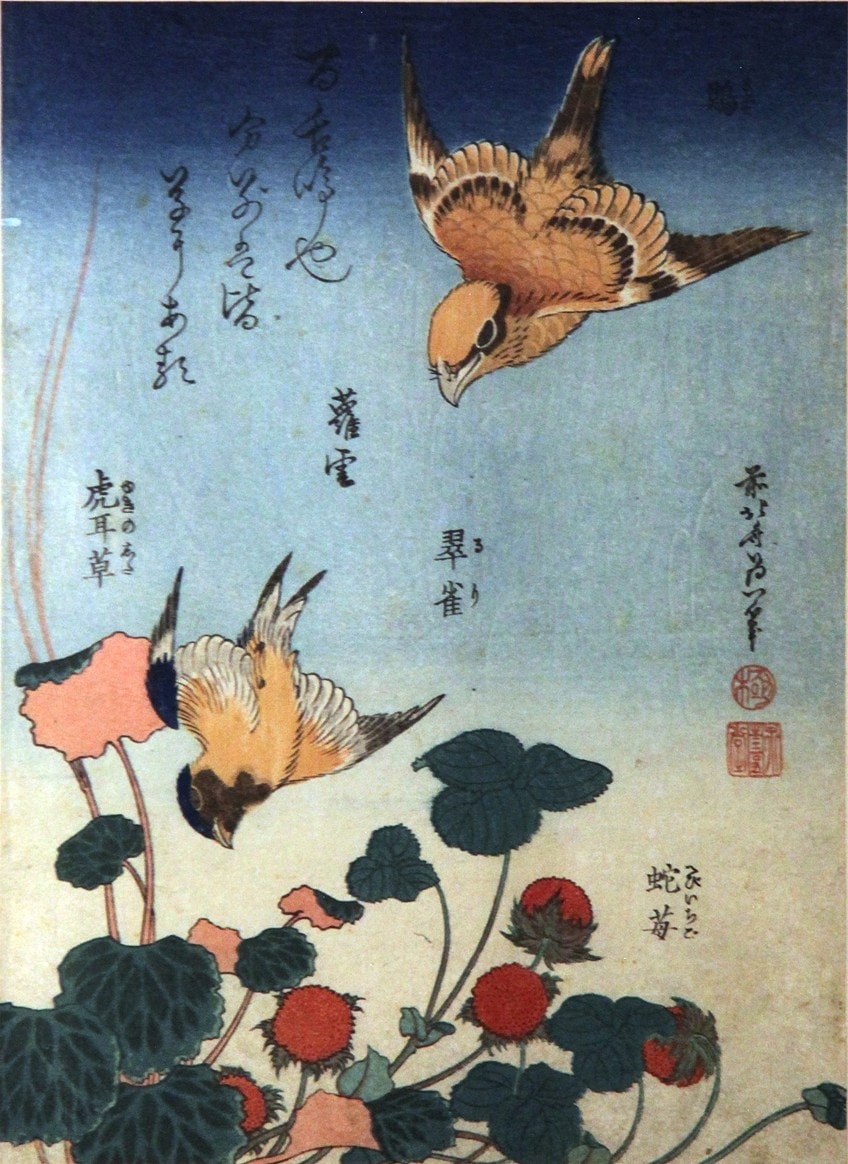 Eat and shrike over strawberries and begonia (c. 1834) by Katsushika Hokusai;Katsushika Hokusai, Public domain, via Wikimedia Eatables
There were many dissimilar styles of painting in the Edo flow of which the Floating World was one. The images of the "Floating World" were inspired past the everyday life of the celebrities and citizens of Edo in the 17th and 18th centuries.
This was a time when downtown Edo served equally a court for the Shogun, attracting nobles and samurais from all over Japan. The subjects for these artists included the actors, sumo wrestlers, geisha, courtesans, and erotic scenes, filling the kabuki theaters and brothel districts on the northern outskirts of the metropolis of Edo.
The increased trade created an environs of debauchery that must take seemed somewhat imperceptible, hence the term "Floating Globe".
The thin veil of modesty provided by the term courtesan in the Western context implies a level of immorality. Only in the Edo Menstruum, there was cypher shameful about sex work. It was legal and extremely popular. As Ukiyo-e developed in the Red Lite district of Edo, information technology boasted a healthy mix of explicit and non-explicit prints.
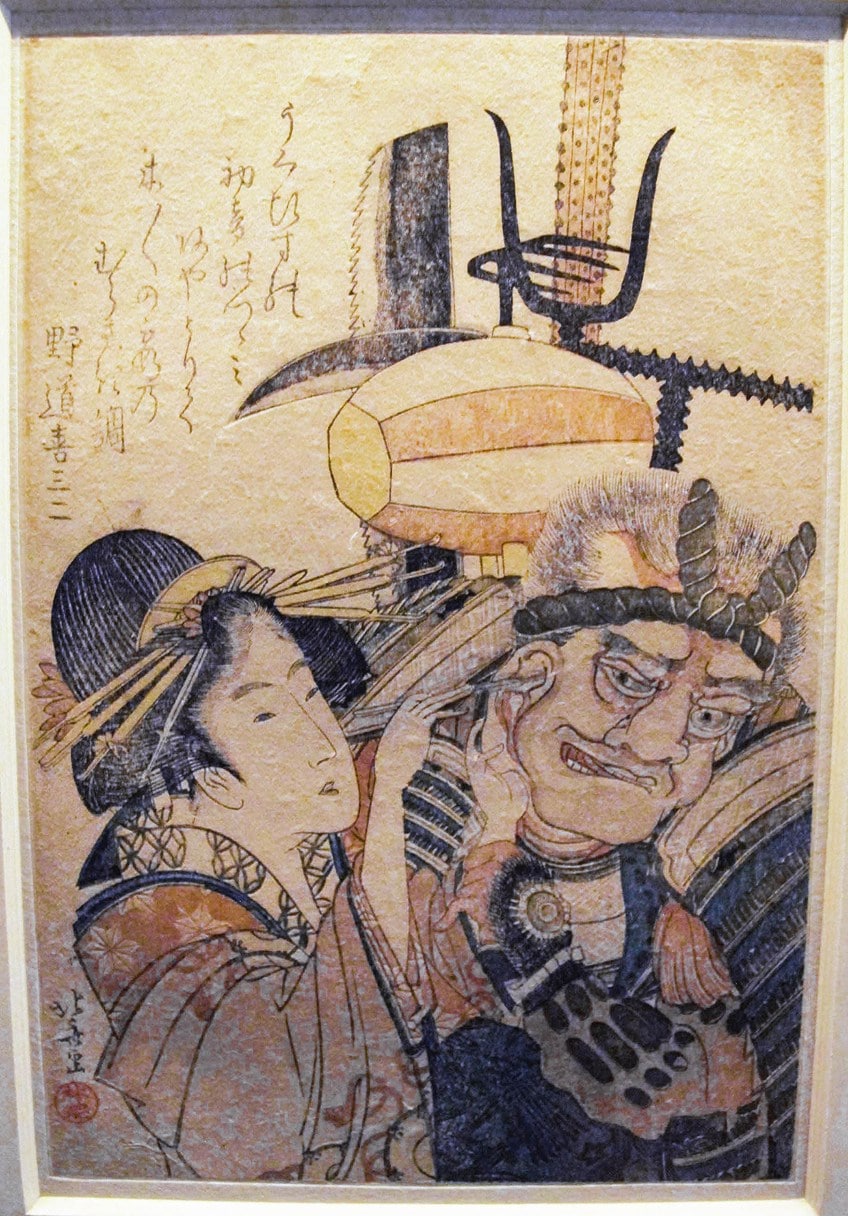 C ourtesan cleaning a warrior's ear (c. 1798-1810) by Katsushika Hokusai; I, Sailko, CC Past-SA 3.0, via Wikimedia Commons
The collectible woodblock prints became a sensation much like modern-day trading cards. At that place was a steady demand for new prints to collect. Although printed past paw, mass production made them highly profitable for publishers. Considering of the mass production, they were considered low in social prestige whereas traditional painting remained prestigious.
Yet, Ukiyo-e fabricated art relatable and accessible to all classes as these prints could be bought for the price of a bowl of noodles.
The Ukiyo-e artful differed in several ways from Western art. The first was perspective. The vibrant colors of Ukiyo-e were contrasted by the bottomless range of grays and browns that had typified Western art at the time. The Edo Flow too stood out for its unique use of shapes and forms. Artists had not strived for realism but favored structured drawings that emphasized atmosphere and free energy.
Early Career
Past the fourth dimension Hokusai is born in 1760, the movement had existed for more than a hundred years. However, he was built-in in a time of great change. In the mid-18th century, Edo had go the biggest city in the world with a population of one million. Information technology had become a sophisticated consumer gild.
Though they were once considered the everyman social class merchants, the metropolis rose through the ranks every bit the economy boomed. They could afford now pedagogy, travel, books, and art.
At the age of 14, he apprenticed with a woodblock cutter, so he learned this important aspect of the production of Ukiyo-e. It began with a publisher who would commission an image from the creative person who fabricated a cartoon on sparse paper. Then the original drawing was reversed, glued to the block, and rubbed down with an instrument called a baren.
The carver then peeled off about of the newspaper while it was still damp from the moisture of the gum, leaving the lines of the original epitome on the surface of the woodblock. The castor line was then carved onto the woods. The original design was destroyed in the process, so the carvers had to possess immense skill and precision in order to mimic it.
In 1778, when Hokusai was 18-years-onetime, he began studying under the master printmaker Katsukawa Shunshō, who was influential to the Floating World school of pop art, producing thousands of color woodblock prints of the kabuki superstars of the twenty-four hours.
A year into his studies, Hokusai published the start series of his own Ukiyo-e prints depicting kabuki actors. These early prints match Katsukawa's style. Early Hokusai art was fabricated under the name Shunrō, which he was given by his chief.
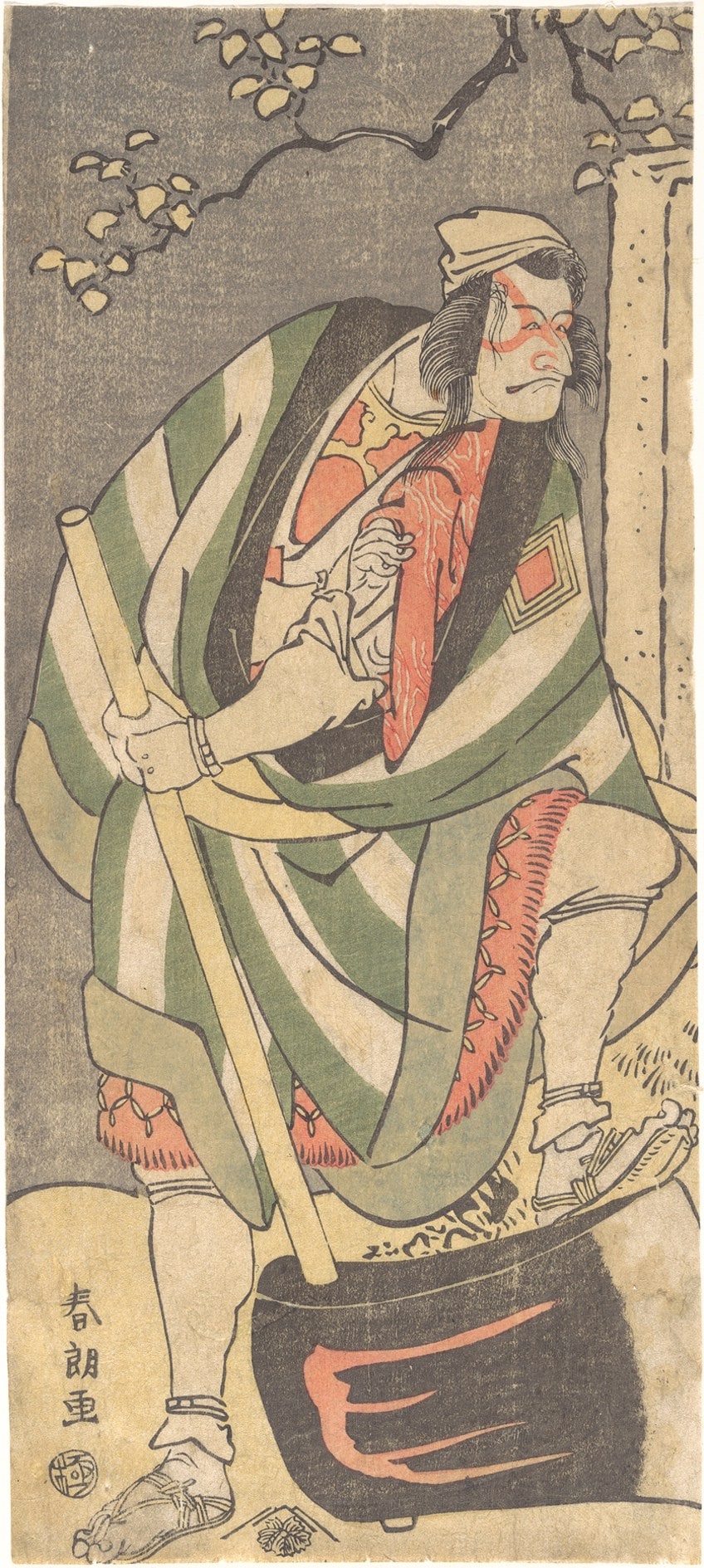 Ichikawa Ebizō equally the Saint Monkaku Disguised every bit a Bandit (1791) by Katsushika Hokusai. This is a print of a kabuki histrion, signed "Shunrō";Hokusai, Public domain, via Wikimedia Eatables
Hokusai's mentor Shunshō died in 1793 and his successor Shunkō relieved Hokusai from his duties at the studio. This setback brought almost a breakthrough in Hokusai'south creative journey. Now that he was no longer busy designing repetitive pictures of courtesans and celebrities, he was able to expand his subject thing.
He turned his focus on nature and the daily lives of ordinary Japanese people.
Manga
Hokusai began using the name we know him by around 1800. Hokusai means "n studio", a reference to the North Star, an important deity in Nichiren Buddhism. From 1804 until 1815, he illustrated the popular novels of Takizawa Bakin.
His success multiplied in 1811 when he began traveling and making random drawings of his observations. While visiting a friend and colleague in Megoria, a publisher saw his drawings and suggested that he compile them and publish a book.
The book title Hokusai Manga came from Hokusai himself, though his pregnant is quite different from the popular comic books of today. "Manga" in Hokusai times meant random or informal drawings or sketches. While it has no storyline, Hokusai's experience in novel illustration influenced his Manga.
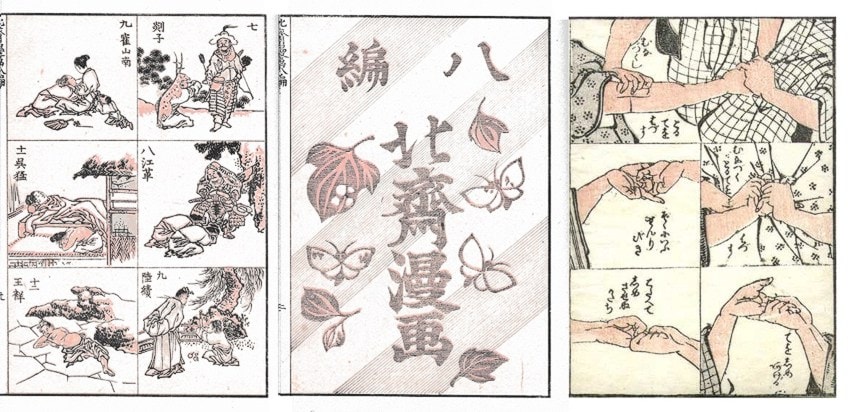 P historic period taken from Katsushika Hokusai'southward Hokusai Manga vol. 8: Self-defence force techniques (c. 1817); Katsushika Hokusai (1760-1849), Original uploader? Nataraja, Public domain, via Wikimedia Commons
The first in the Hokusai Manga series was Quick Lessons in Simplified Cartoon (1812). The woodblock printed picture books included lots of models for people to re-create as training. The images include landscapes, compages, working people, animals, and fictional characters.
The book has an entire department of beautifully fatigued and labeled images of various types of fish.
Around the aforementioned fourth dimension, he besides published Kinoe no Komatsu a widely popular volume of erotic images. The famous Dream of the Fisherman's Wife (1814) depicted a woman embroiled in sexual ecstasy with a couple of octopuses.
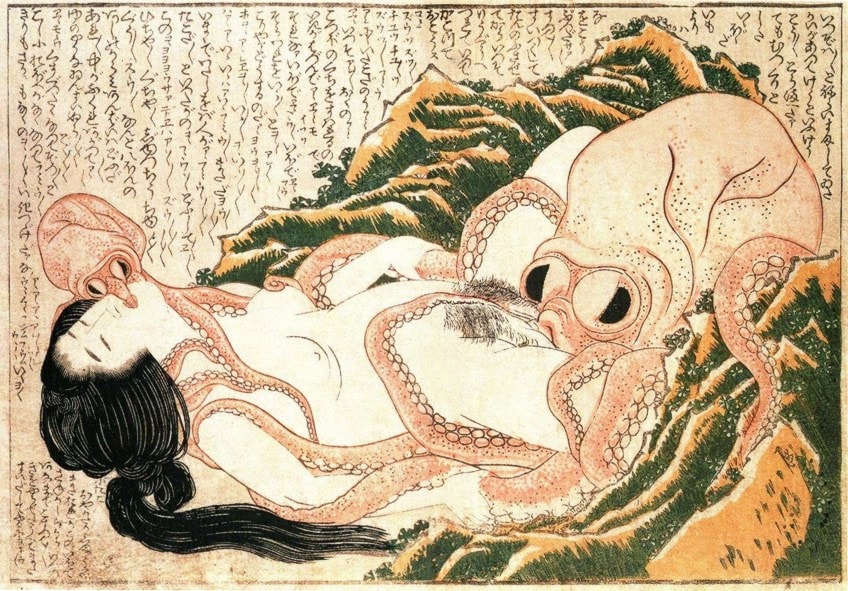 Dream of the Fisherman's Wife (1814) by Katsushika Hokusai; Katsushika Hokusai, Public domain, via Wikimedia Commons
Having been published around the same time, these books were hugely popular and enormously influential. Hokusai'southward Manga can exist seen as a foundation for modern Manga. Hokusai published 12 volumes of Hokusai's lost Manga in his lifetime, three more were published afterward his death.
Katsushika Hokusai's Painting Style
Hokusai had worked with European perspective for some time, but the lessons he had picked upward throughout his middle years began manifesting in his later years. In 30-Six Views of Mount Fuji (c. 1829–1832), he combined a distinctly Japanese manner with a distinctly Western manner, taking his newfound techniques to their optimal resolution.
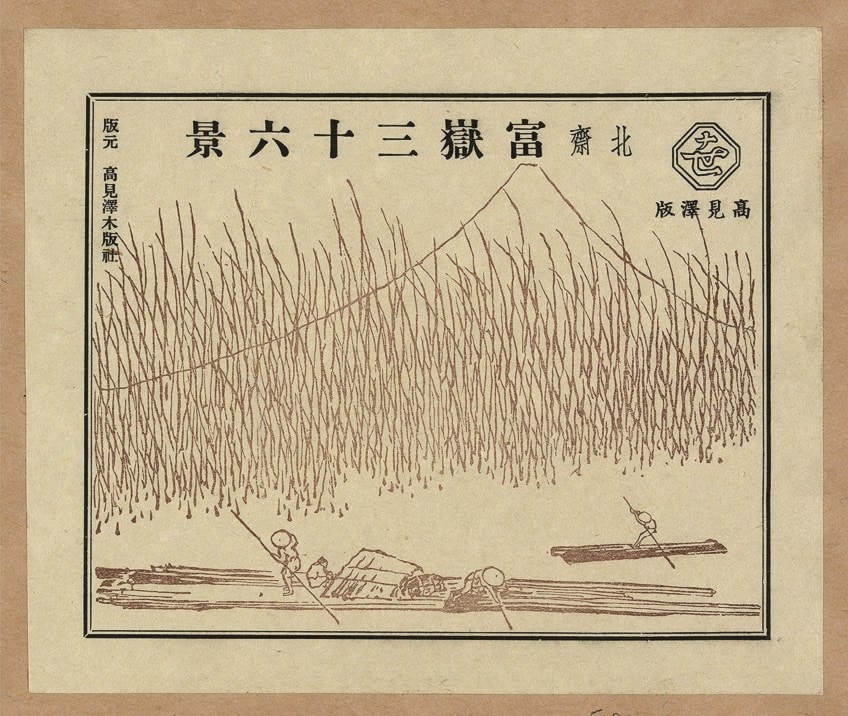 Pictorial envelope for Katsushika Hokusai's 36 views of Mount Fuji series, 1890; Katsushika, Hokusai, 1760-1849., Public domain, via Wikimedia Commons
Perspective
Traditional painting styles like Yamato-e, which preceded Ukiyo-e, took the traditional Japanese perspective of the absent roofs. Classical Asian perspective depicted things higher up to show that they were at a distance. Western artists controlled the viewer's bespeak of view whereas Japanese mural painters offered no marked point of access.
Time was also determined in Western art, but Japanese art had a more fluid sense of time, which included multiple dimensions.
Dutch merchants were allowed ii trading ships per year. This was practically the but direct connection betwixt Edo and Europe. Provided they had no trace of Christianity, Western books and pictures were embraced in Edo.
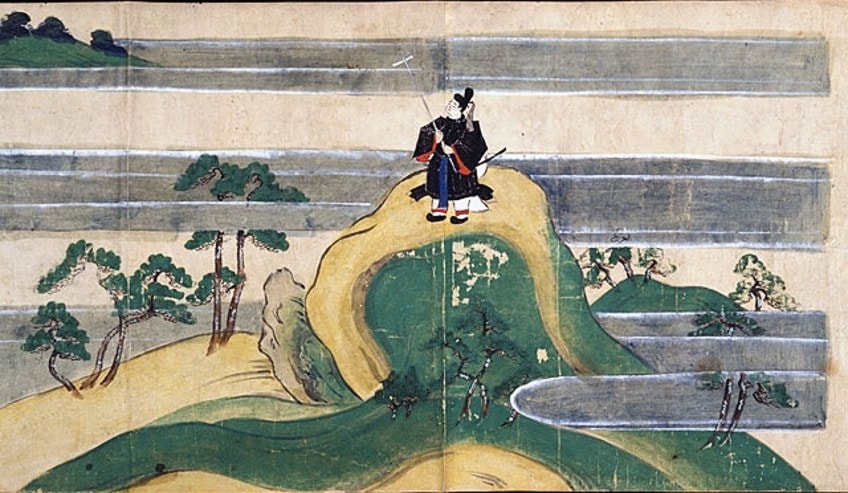 A Yamato-e print called Illustrated Legends of the Kitano Shrine (1219) past an unknown artist; Unknown creative person Unknown artist, Public domain, via Wikimedia Commons
The Japanese had been familiar with the vanishing bespeak since the 1740s. Its inflow had not been exalted in that location as information technology had been in Renaissance Europe. Instead, the Japanese saw it as a novelty. They used the agreeable optical illusion for stage sets and toys.
The lowbrow images of Ukiyo-eastward took to European perspective in the 1780s.
By the early on 1800s, Hokusai had responded to the high need for these perspective pictures with a number of modest prints exploring Western perspectives. Hokusai art depicted Edo through a Dutch lens by simultaneously imitating shading, depth, and linear perspective feature of European art and violating it to incorporate the classical Asian system.
Prussian Blue
During the Edo Period, the Japanese were self-sufficient merely they enjoyed exotic goods. A new pigment would have been very interesting to Japanese artists. In 1829 one such synthetic blueish was invented in Deutschland. The Japanese chosen it Berlin bluish just we know it as Prussian blue.
It was initially imported to Japan by Dutch traders but in the belatedly 1820s, the Chinese began importing too, making it much more affordable. This made it possible to utilise Prussian blue in Ukiyo-e prints.
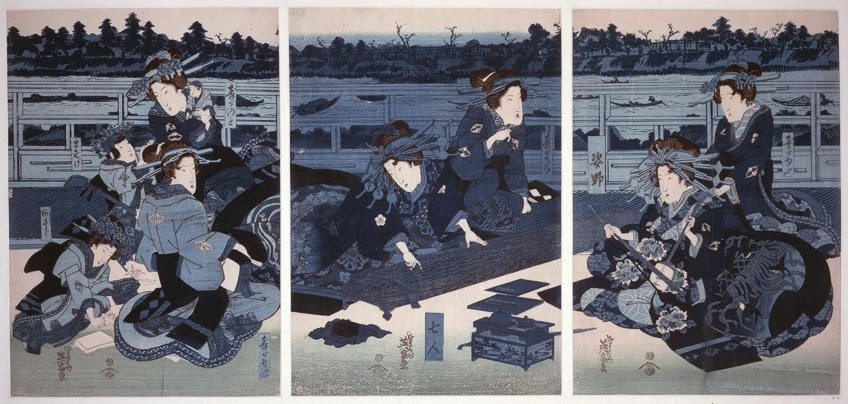 Colour woodblock-printed triptych depicting a group of courtesans from Shin-Yoshiwara district playing music on the upper floor of a restaurant overlooking Sumida River; Nanabito playing the koto and Sugatano playing the kokyu, accompanied by lower-rank prostitutes and apprentices. With Prussian blue, and footling reddish on lips. Designed by Keisai Eise and printed by Tsutaya Kichizo, c. 1830;British Museum, Public domain, via Wikimedia Commons
Compared to previous dejection, Prussian bluish had a greater tonal range but the paint was especially popular because it did non fade as earlier blues did. Earlier Ukiyo-due east prints rarely used bluish because earlier blues faded sometimes within weeks.
The drastic change in color was the result of Ukiyo-e artists being able to explore for the start time, painting the sky, mountains, and water with an improved bluish color.
The Dutch who were fully aware that Hokusai was an innovator, awarded him a big commission for a series of paintings showing typical scenes of Japanese in 1822 when he was already in his 60s. He executed these works through his hybrid Japanese European fashion and the newfound blueish.
Hokusai Artworks
While mural prints were however non every bit lucrative as the kubuki Ukiyo-e prints in the late 18th century, sales would increment as a result of an increase in domestic travel within Nippon. The merchants, pilgrims, and pleasure seekers who visited Mountain Fuji created a need for a new genre of souvenirs in the class of woodblock prints of Japanese mountains fine art. Hokusai artworks offered a new window into Japanese landscapes and people.
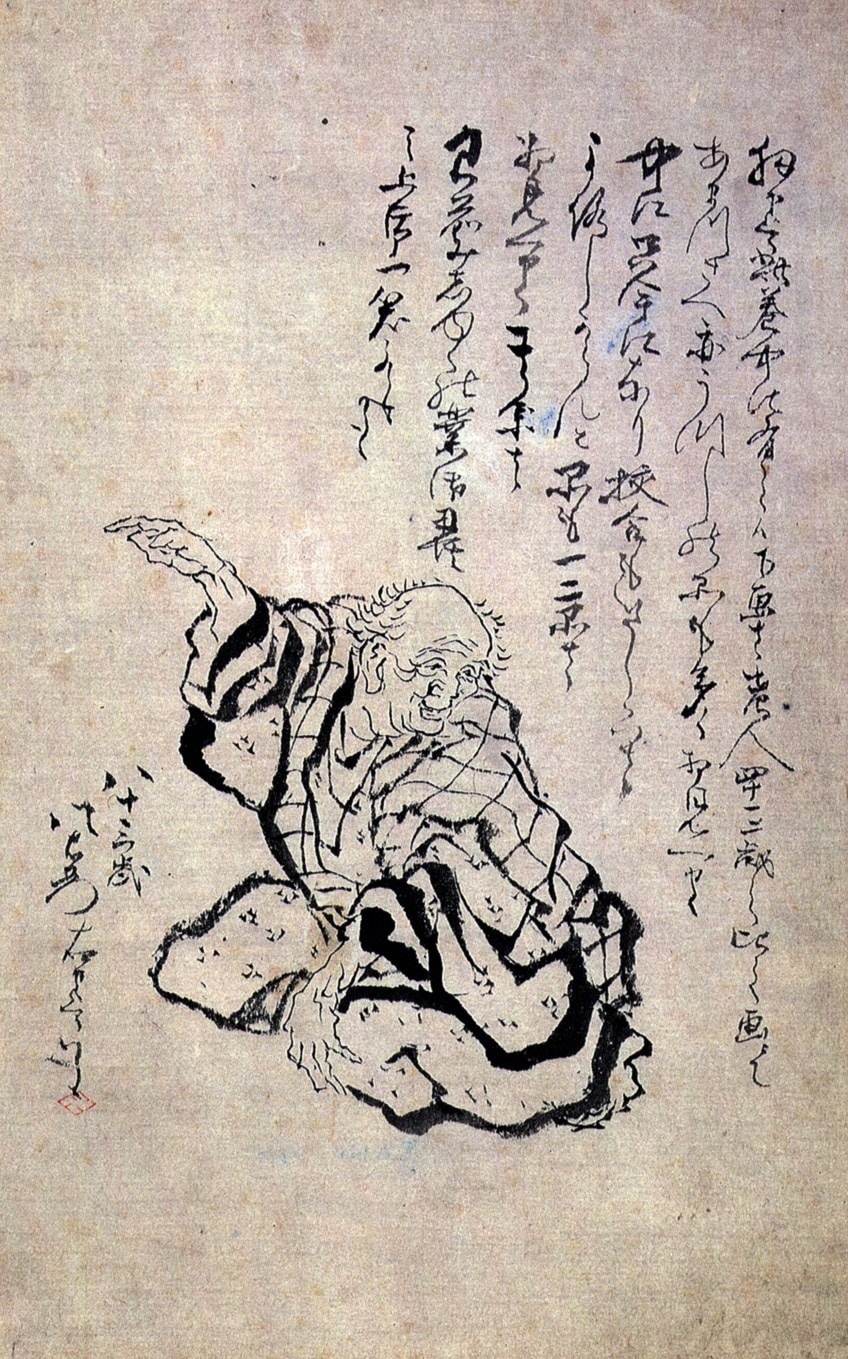 Self-portrait at the age of eighty-three (1843) by Katsushika Hokusai; Public Domain, Link
Xxx-Six Views of Mount Fuji (c. 1829–1832)
Nether his new pseudonym Iitsu, Hokusai was commissioned for Xxx-Six Views of Mountain Fuji (c. 1829–1832) initially to exploit the new colour. The showtime five prints in the series were printed nearly entirely in shades of Prussian blue, including a bit of indigo. Everything including the outlines which were usually printed in black was turned to blue.
Mount Fuji is the highest peak on the Japanese island though it is not a mountain, but an agile volcano. Information technology had long been considered a deity with over 800 shrines dedicated to information technology. It was as well a site for religious pilgrimages. The belief was that the mount was a source of immortality and a seat for the gods.
It represented stability and strength for Japan, which was nevertheless enmeshed in its own civilisation and made Japanese mountains fine art central.
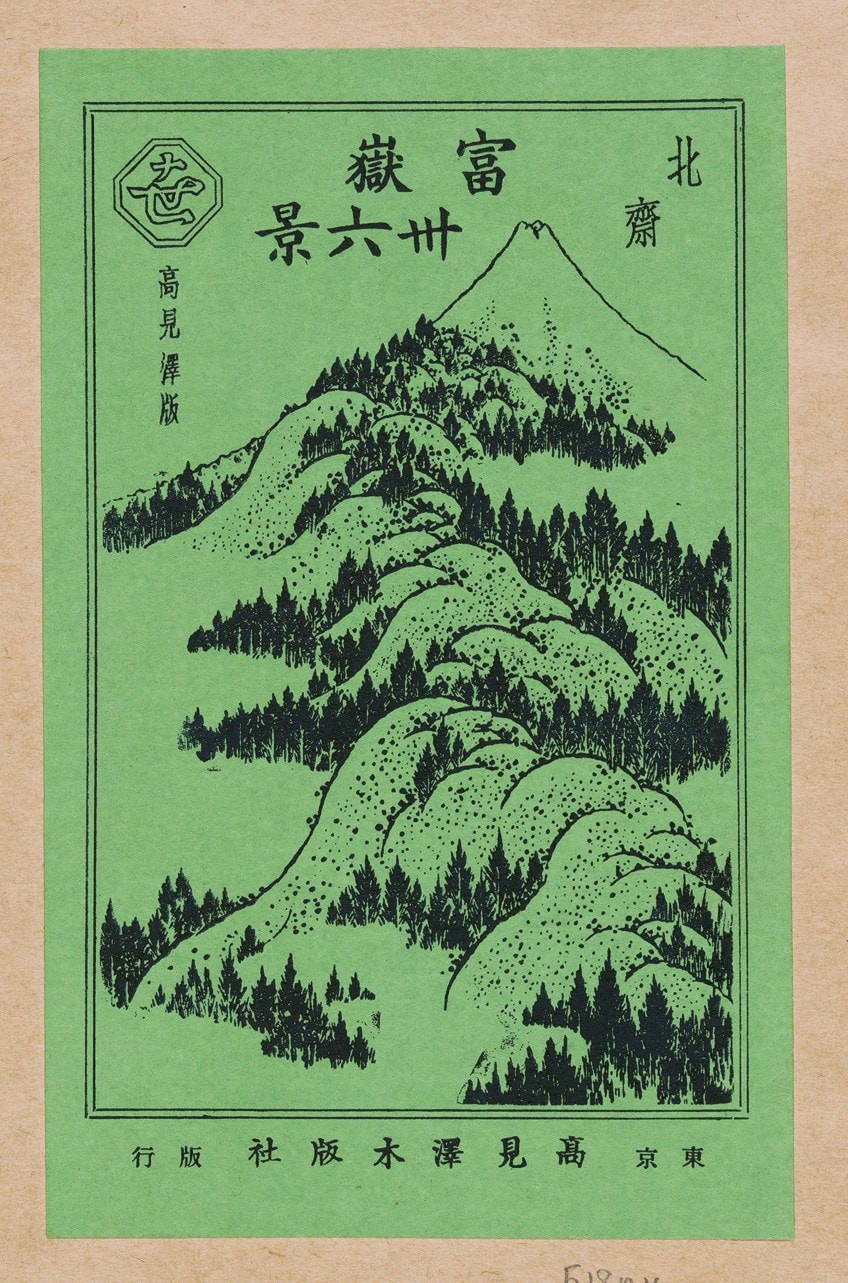 Pictorial envelope for Katsushika Hokusai's 36 views of Mountain Fuji series, 1890;Katsushika, Hokusai, 1760-1849., Public domain, via Wikimedia Commons
In the idyllic series of cake prints entitled Xxx-Six Views of Mount Fuji, Hokusai indulges from almost every angle his obsession with this sacred landmark. Across 36 landscapes Mount Fuji shows up through the clouds, above the city, and on the horizon.
Hokusai would put everything he'd learned about way, colour, and perspective over the by half-dozen decades into his "Thirty-6 Views of Mount Fuji".
Hokusai was interested in the relationship betwixt human activeness and the mountain. He depicted people in the landscape, traveling, getting their hats blown off past the wind, or working the land. In one of the scenes, travelers are caught in a thunderstorm. A lightning flash at the back of the moving-picture show causes a strobe-light issue in the nighttime thunderous sky.
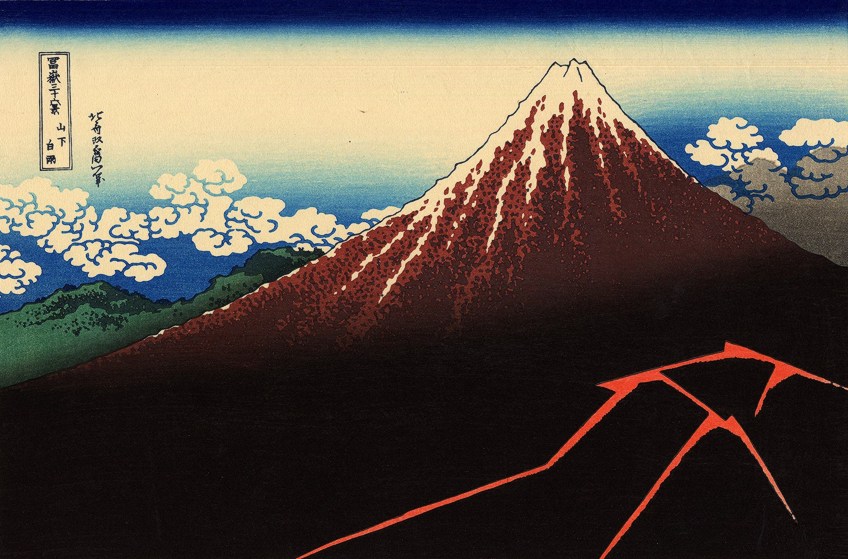 Rainstorm beneath the meridian (1830) by Katsushika Hokusai, number 32 of the series Thirty-six Views of Mount Fuji; Katsushika Hokusai, Public domain, via Wikimedia Eatables
The Swell Wave (1830)
| Proper name | Under the Wave Off Kanagawa |
| Yr | 1830 |
| Size | 25 cm x 37 cm |
| Medium | Woodblock print |
1830 Hokusai began making what would become his most famous paradigm when he was over lxx years old. The Cracking Wave off the Coast of Kanagawa (1830) is actually titled Under the Wave Off Kanagawa, though people generally telephone call it The Smashing Wave. The color woodblock impress The Great Wave produced roughly 8000 prints. The mass-produced poster-size prints were affordable and accessible, thank you to the democratic art course of Ukiyo-e.
This print is viewed equally a quintessentially Japanese image, just it is a hybrid of Japanese and European styles. Hokusai arranged the motion-picture show and so that Mount Fuji which is in the center of the limerick, and the highest point in Japan appears dwarfed past the humungous moving ridge in the foreground.
Hokusai'south use of the then-new Prussian blue captures the brightness of the sea with a harmony of contrasts. There is a dynamic movement of the claw-like figures of the wave, which occupies two-thirds of the epitome. The foam from The Swell Wave descends onto the mount like snow falling onto the peak of Mount Fuji which remains covered all twelvemonth circular.
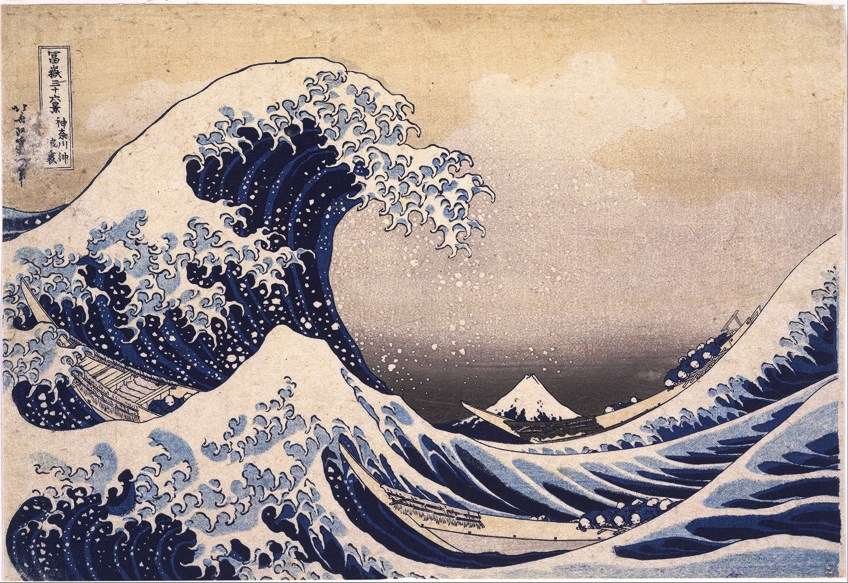 The Cracking Wave Off the Coast of Kanagawa (1830-1832) by Katsushika Hokusai; Katsushika Hokusai, Public domain, via Wikimedia Commons
The Smashing Wave captures a distilled moment equally this wave is about to crash down onto the three fragile boats beneath. Tossed near in the waves the 3 fast delivery boats are attempting to deliver a catch of live fish from a fishing fleet to the markets in Edo.
In Hokusai'due south typical style, he depicts heroic working people and humanizes them through their see with nature and the uncertainty of whether they will make it to shore.
His before attempts at waves like Cargo Boat Passing Through Waves (1805), showing a large wave about to hitting a boat, and some other print, Jump at Enoshima (1797), which depicts a wave breaking at the beach, were fairly static in comparison. His earlier waves which were decades prior did not finer register as water.
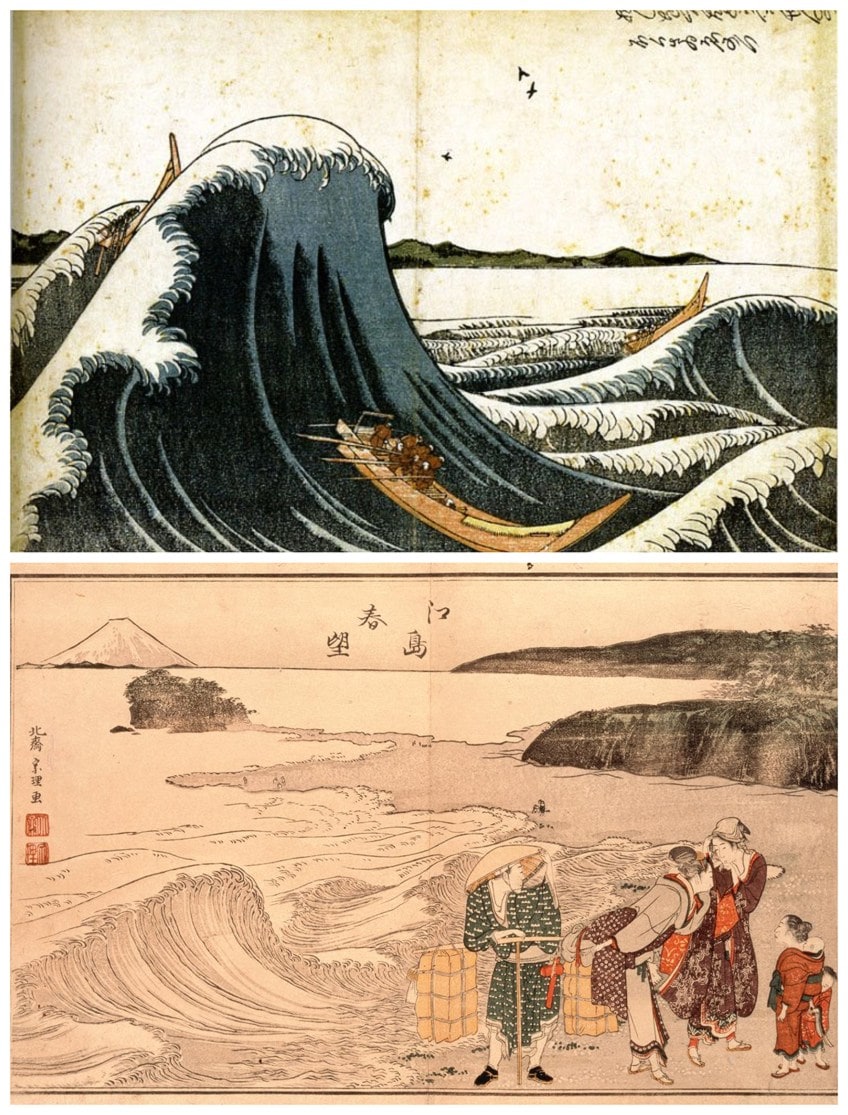 TOP: Cargo Boat Passing Through Waves (1805) by Katsushika Hokusai; Katsushika Hokusai, Public domain, via Wikimedia Commons | BOTTOM: Jump at Enoshima (1797) by Katsushika Hokusai;Katsushika Hokusai, Public domain, via Wikimedia Commons
Kanagawa which is south of Edo shows a distance from Mount Fuji that has a hint of dread. Even though Japan remained isolated, the fearfulness of invasion past sea was palpable. The remainder of the world was being industrialized and the Japanese were concerned about foreign incursions. The ocean which had protected Japan's peaceful isolation for two centuries was condign its downfall.
Hokusai's "Great Wave" encapsulates Japan's fear of an uncertain future.
Crimson Fuji (c. 1830)
| Proper name | Red Fuji |
| Year | c. 1830 |
| Size | 25.four x 36.5 cm |
| Medium | Woodblock impress |
Fine Current of air, Clear Forenoon is meliorate known as Red Fuji (1830). In Hokusai's earliest impressions, the red is quite low-cal, almost faded. Withal, the blue outline on the edge of the mountain reveals that that coloring was non accidental. The more nuanced shade of red was harder to print for various reasons and the publishers began to cutting corners which led to the implementation of the bright Red Fuji.
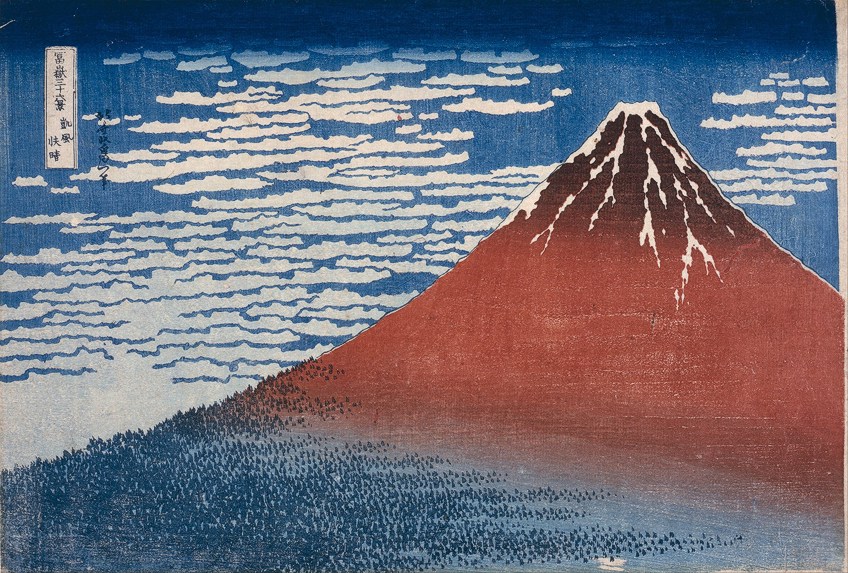 Fine Air current, Clear Morning (Carmine Fuji) (c. 1830) by Katsushika Hokusai; Katsushika Hokusai, Public domain, via Wikimedia Commons
The original light red revealed the quality of light right earlier dawn. The bright reddish in this popular print is praised for its monumental and abstracted design. Merely the subtly is being missed. The triangular trees of the mountain forest seem to be printed from three different blocks. They bring depth through the various shades of green in which they were printed.
Interestingly, Hokusai's nearly important print in Japan is not "The Great Wave" merely "Red Fuji". Since Mountain Fuji is an of import part of Japanese national identity, Japanese mountains art was popular. The Japanese did not want Fuji at a distance, only upwardly shut in its full celebrity.
Mod Fine art
On July viii 1853 Nihon'due south cocky-imposed isolation came to an cease when armed ships sailed uninvited into Tokyo harbor on behalf of the U.s. authorities demanding that the Japanese start trading with them. Japanese art which had developed independently for over two centuries was finally revealed to the rest of the globe.
One of the reasons why Japanese art was the first not-Western art form to be "discovered" by the Westward was because it was partly Western. The images had their own aesthetic but they seemed rather familiar to the Western audition.
The French became fond of Japanese prints in the 1800s and this frenzy for Japanese art became known equally Japonisme. Information technology occurred shortly after Hokusai's decease in 1849. The obsession with Hokusai artworks and other famous Japanese artists like Kitagawa Utamoro, Utagawa Hiroshige, and Utagawa Kuniyoshi influenced European mod art.
Vincent van Gogh would produce Starry Night (1889) which was greatly inspired by Hokusai'south Great Wave. In a alphabetic character, van Gogh wrote: "All my fine art is to some extent influenced past Japan." Monet is among the many artists who expressed admiration for Japanese art. Monet owned 23 prints by Japanese artists. In Manet's Portrait of Zola (1867-1868) you see the Utagawa Kuniaki Ii print Sumo Wrestler Omaruto Nadaemon of Awa Province (1860) clearly in the background.
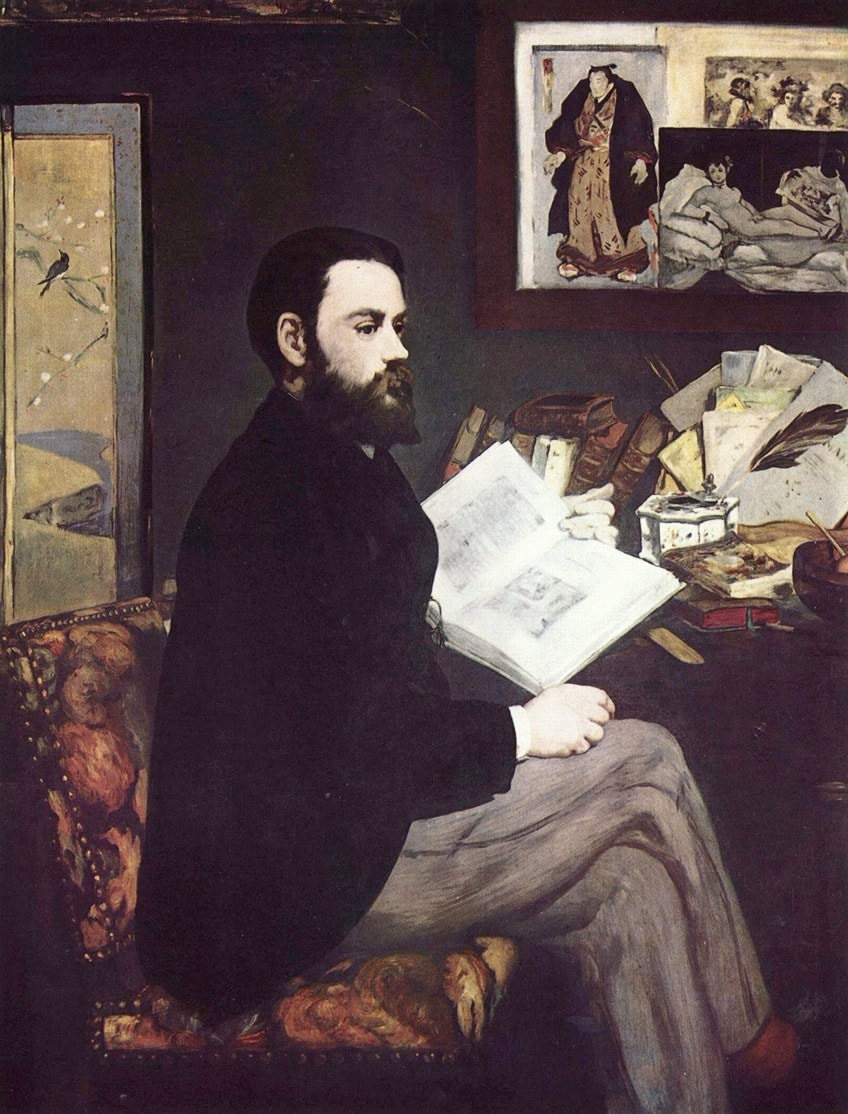 Portrait of Emile Zola (1868) by Édouard Manet;Édouard Manet, Public domain, via Wikimedia Eatables
The Japanese influence is present in Paul Gaugin'southward The Wave (1888), Claude Monet's La Japonaise (1876), Edgar Degas' Madame Camus (1869-1870), Gustav Klint'due south Posthumous Portrait of Ria Munk III (1917-1918), James Abbott McNeill Whistler's Caprice in Majestic and Gold: The Gold Screen (1864), Mary Cassatt's Adult female Bathing (1890-1891), Alphonse Mucha's Winter (1896), and Pierre Bonnard's Woman in Checkered Clothes (1890-1891).
Although Japanese prints inspired Modernist artists, it is modernism that ultimately brought Japanese woodblock printing to an end. It persisted subsequently western press methods came to Japan surviving to effectually 1905 when woodblock prints finally gave way to new media such as lithography and photography.
Still, in the 1910s, Ukiyo-eastward prints were somewhat revived as a classical fine art grade.
"The Old Man Crazy to Paint"
In 1834, Hokusai started calling himself Gakyō Rōjin, which means "the former man crazy to paint". Hokusai produced some of his best work in these final decades. He had only begun Thirty-Six Views of Mountain Fuji at the age of 70. Every bit he said himself: "Until the age of lxx, nothing I drew was worth notice. At 73 years, I was unable to fathom the growth of plants, trees and the structure of birds, animals, insects, and fish."
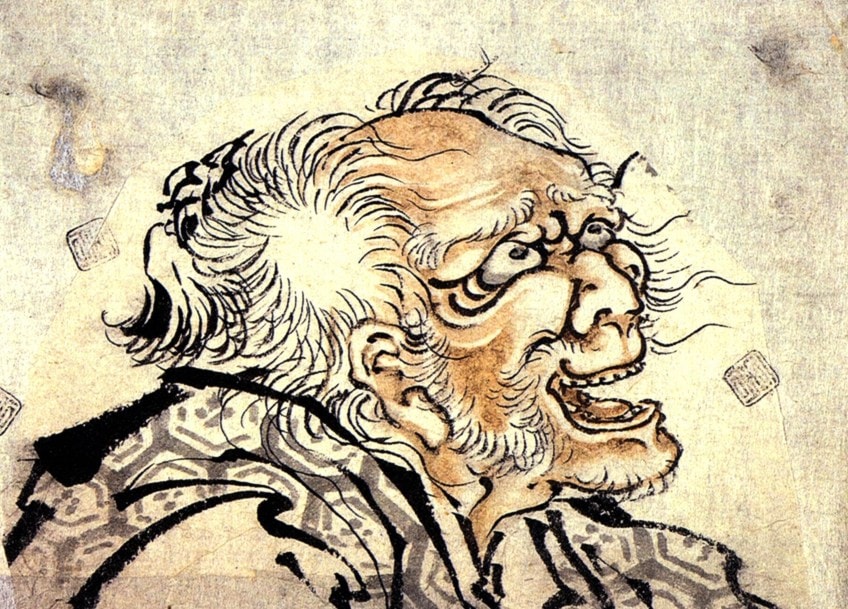 Head of an old man (early 1840s) by Katsushika Hokusai; Public Domain, Link
Hokusai moved to Obuse when he was 83 and his eccentricities expanded. He worked from dawn to after dusk dedicating his life to art. He started his day with an exorcism which involved painting a Chinese lion on a piece of paper and then throwing information technology out the window to ward off evil spirits. He stopped cleaning and would let his studio fester with dirt and clutter and when it became unbearable, he would simply motion, which he was said to take done 93 times.
Hokusai paintings, sketches, and prints exceed the tens of thousands.
At 88, he began focusing on painting, signing his work with the character 100 and a red seal as a talisman for immortal life. He was convinced that he would alive to 110 which he envisioned as his artistic prime. He wrote "if sky volition beget me five more than years of life, then I will become a truthful artist."
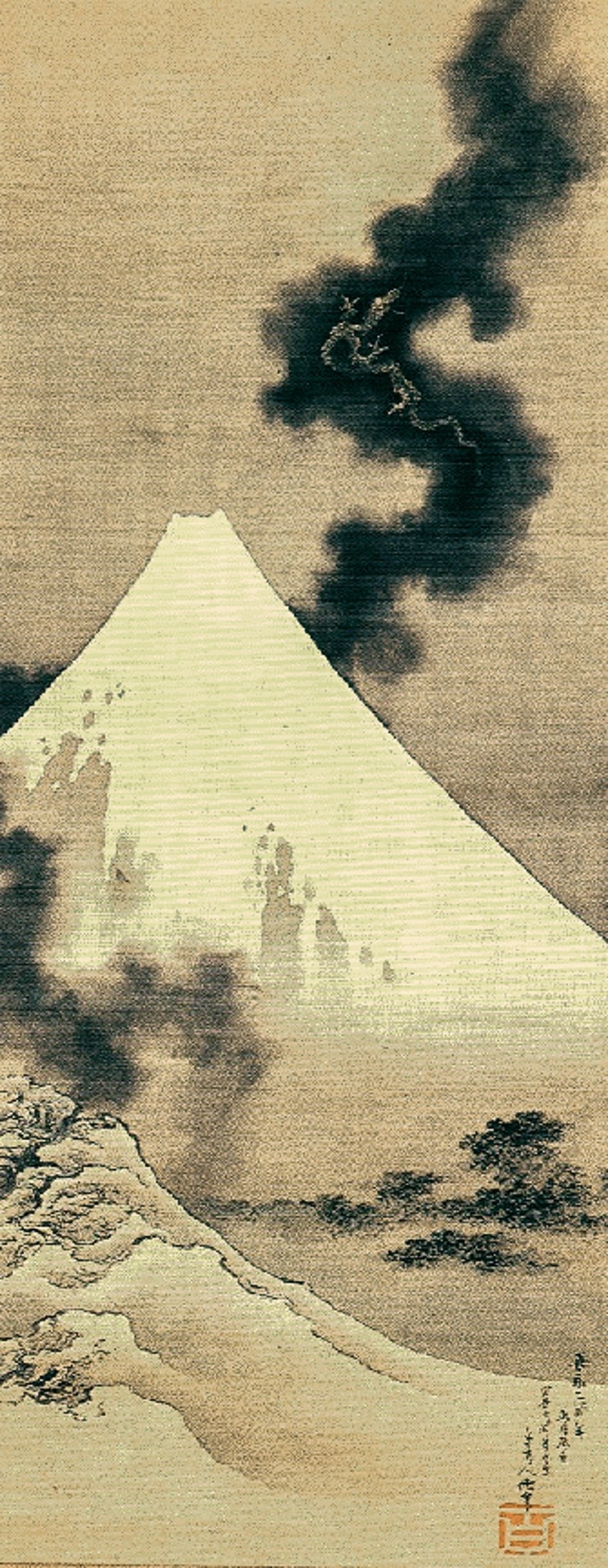 Dragon flying over Mount Fuji (1849) by Katsushika Hokusai; Katsushika Hokusai, Public domain, via Wikimedia Eatables
The concluding of the Hokusai paintings, Dragon flight over Mountain Fuji (1849), was his actual peak. Though he had been painting dragons for decades, he finally seems to take cracked information technology in his 90s. The image synthesized the lessons of his long career. Past using the tone of the paper equally the highlights, he gave himself no room for error. His simplified Mount Fuji is mounted past a globe-trotting dragon ascending into the heavens. It seems like a self-portrait. As if he is behest his last bye to the viewer.
In the inscription, Hokusai wrote: "…I was born in a dragon year, I'm painting this on a dragon day in my 90th year". The Katsushika Hokusai biography would end that year, which proves that he continued experimenting and producing until his dying day. His tombstone bore his last pseudonym Gakyō Rōjin, the "Old Man Crazy to Paint".
Often Asked Questions
How Many Prints Are in Thirty-Six Views of Mount Fuji?
This is a play a trick on question because the series was and then popular that Hokusai ended upwards making ten more, so at that place are really 46 in full. Additionally, Thirty-Six Views of Mount Fuji was so successful that information technology led to the commission of The 100 Views of Mountain Fuji.
Was Hokusai Too a Functioning Artist?
Yes. He was known to wow audiences with street performances during which he painted huge images spanning hundreds of feet using buckets of ink and a broom. He too entertained the royal courtroom of the Tokugawa shōgun when he painted a large blue curve and then dipped a chicken's feet in carmine paint and chased it across the sail.
Did Hokusai Work Lone?
No. Artists would just pattern the initial prototype and were not involved in the printing procedure. First, the publisher would committee the piece of work, then the creative person, and so the block cutter, and the printer. Because the fact that he likewise had followers, disciples, and students, Hokusai probable worked with a dedicated team of skilled craftsmen.
Did Hokusai Make Erotica?
Yes. Ane of Hokusai'south nigh well-known prints depicts a adult female having sex activity with an octopus.
Can You Tell How Many Blocks Were Used by Looking at a Hokusai Impress?
It tin be difficult, only normally, if yous can discern the number of colors, then that is an indication of how many blocks were used. Printers ofttimes risked using the same block if there was no adventure of the two colors intermingling. They besides used gradation and layering, which can make it hard to tell how many blocks were used.
Source: https://artincontext.org/katsushika-hokusai/

Post a Comment for "Public Domain Fish Art Painting Pinterest Utagawa Kuniyoshi Dragon"