Treating uncontrollable hunger in children caused by rare genetic disorder
Advertisement
Wellness
Treating uncontrollable hunger in children caused by rare genetic disorder
A special diet and growth hormones may offer hope for children born with Prader-Willi syndrome.
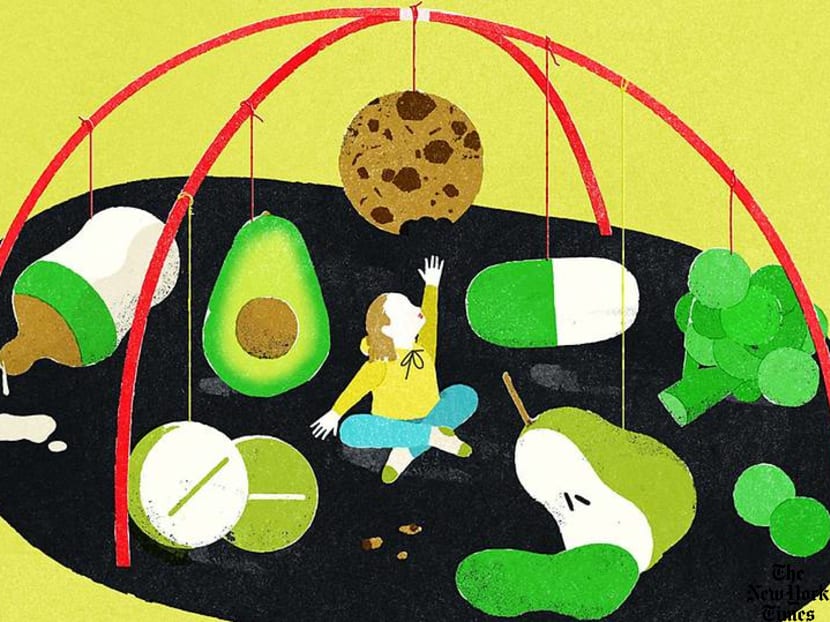
(Art: The New York Times/Gracia Lam)
When a child is born with a rare disorder that few doctors recognise or know how to manage, it tin can pay big dividends for parents to be proactive, acquire everything they can nearly the condition and, with adept medical guidance, come up up with the best way to treat it.
That is the approach Lara Pullen of Chicago adopted when her son, Kian Tan, was built-in 15 years agone terminal calendar month at 3.4kg, seemingly well-formed and healthy.
But within 24 hours, Pullen, who already had two daughters, said Kian had stopped moving, wouldn't nurse and felt as floppy every bit a rag doll.
Two and a one-half weeks afterward, a genetic test showed that Kian had Prader-Willi syndrome, a genetic disorder that occurs once in every 15,000 to 25,000 live births.
While at first it is a struggle to get plenty food into these babies because they're too weak to suck, within 2 or three years, their primary symptom is an insatiable appetite that results in extreme obesity, unless the child, who is driven past constant hunger, is kept from sneaking and stealing food.
READ: Tips on how to heighten your children to be vegetable eaters
Prader-Willi syndrome is caused by the failed expression of several genes on chromosome 15 derived from the child'due south begetter.
The genes are either missing or inactivated by a mistake that occurs during sperm development or, in some cases, the father's entire chromosome fifteen is not inherited by the foetus.
The disorder is only rarely inherited, but when a male parent has Prader-Willi syndrome acquired by a deletion in chromosome xv, there'south a 50-per-cent take a chance each child he fathers will inherit the defective chromosome.
In addition to an excessive ambition, its range of symptoms includes curt stature, sleep apnoea, extreme daytime sleepiness, visual defects, underdeveloped genital organs, poor coordination, mild to moderate intellectual inability, speech communication issues, a loftier tolerance for pain, temper tantrums, obsessive behaviours and blood sugar irregularities.
Pullen was adamant to give Kian the all-time possible chance at near-normal evolution.
While treatment of Prader-Willi syndrome has centered on preventing obesity past limiting calories and keeping food under lock and key at all times, Pullen, who, like her husband, is an immunologist, decided with the help of Kian's doctors to focus on protecting his brain also as controlling how much he ate.
"When Kian started solid foods at half dozen months, I gave him lots of fats to help grow his encephalon – avocados, egg yolks, whole-milk yogurt – high-calorie foods that gave him the best blindside for the buck when it was and then difficult to get him to consume," his mother said in an interview.
"And so later, when hyperphagia kicked in, I kept carbohydrates low considering he got hungry again very soon afterward eating them."
READ: Junk digital diet: Children drowning in visual equivalent of eating 'pizza and sweets'
The diet, along with nightly shots of growth hormone kickoff in infancy, has kept Kian on a normal growth bend and appropriately lean. He has also thrived in schoolhouse, having fabricated the honour gyre last term.
Only Kian's story doesn't stop at that place, and what follows could, with further research, prove to be a godsend for other children similarly affected.
Pullen pointed out that in improver to uncontrollable hunger, the common childhood symptoms of Prader-Willi syndrome suggest that neurological abnormalities may underlie the disorder's nearly challenging problems.
In support of her theory, Pullen and Maria Picone just published in the Journal Of Pediatric Pharmacology And Therapeutics a preliminary report documenting benefits in iii Prader-Willi children of the drug pitolisant (Wakix).
Pitolisant is licensed in Europe to care for narcolepsy, a neurological sleep disorder.
Picone, founder of Trend Customs, a networking platform for those with rare disorders, also has a child with the syndrome.
She and Pullen are co-founders of the Chion Foundation, based in Chicago, which does research in rare diseases.
READ: Chemicals in food may harm children, paediatricians' grouping says
The children in their report are among 10 with Prader-Willi syndrome who take at present tried pitolisant.
Nine are said to have experienced meaning improvements in quality of life, including more normal sleep patterns, increased daytime alertness and better mental performance.
The children were reported to take shown improvements within days of starting on a depression dose of the drug that was gradually increased.
Several of the children, including Kian, are featured in a video Pullen produced to show at a professional person conference in Canada last calendar month.
Admittedly, this was not a controlled report; information technology is subject to parental bias and therefore only suggestive of the reported benefits.
Many case reports of apparently successful treatments neglect to hold upwardly in clinical trials.
But the known biological activeness of pitolisant supports the effects observed in the children with Prader-Willi. Pullen explained that pitolisant is a highly selective drug that acts on histamine three or H-3 receptors in the brain, enhancing the activity of neurons that improve wakefulness.
But that's non all H-three receptors exercise. In addition to affecting sleep-wake cycles, H-3 receptors in the brain are involved in regulating hunger, noesis, learning and muscle tone.
In that location are also H-3 receptors in the stomach, gut, pancreas and testes, all of which function abnormally in Prader-Willi children.
READ: How to deal with the 'picky eating' phase of your toddler
Pitolisant, Pullen said, "seems to normalise systems that are dysregulated in the bodies of individuals with Prader-Willi syndrome". Currently, the drug is available only in pharmacies in Europe.
With or without drug treatment, the nutrition of a child with Prader-Willi syndrome needs careful attention, preferably guided by a dietitian knowledgeable most the disorder, Dr Shawn McCandless and the genetics committee of the American University of Pediatrics recommended.
Once the child develops an uncontrollable ambition, as piddling every bit 60 per cent of the calories needed by an unaffected child of the same size might be needed to reach normal growth.
But it is important to clinch that all essential nutrients, including adequate protein, are included in the kid's nutrition.
Dr McCandless, a paediatrician and medical geneticist at the Children's Hospital Colorado, emphasised that "relatives and social contacts must be educated to realise that 'sneaking' food to the kid with Prader-Willi syndrome is not an appropriate method of communicating amore".
READ: What practice you do when your child decides to get a vegetarian?
Appropriate direction of behavioural problems is also of import and often requires the aid of a developmental psychologist or the kid'southward paediatrician.
Dr McCandless suggested that, as with most children, the best arroyo is to reward desired behaviours and whenever possible, ignore those that are undesirable.
But using food as a reward or penalty is likely to exist counterproductive and should e'er be avoided, he said.
Every bit children with Prader-Willi syndrome approach young machismo, various compulsive behaviours may emerge, including smoking cigarettes.
Some may develop low or anxiety or even psychosis, so parents need to exist alarm to early signs of such problems and seek prompt medical attention.
By Jane Brody © The New York Times
This article originally appeared in The New York Times.
https://www.nytimes.com/2019/06/03/well/live/a-pioneering-handling-for-uncontrollable-hunger.html

Recent Searches
Trending Topics
Source: https://cnalifestyle.channelnewsasia.com/wellness/pioneering-treatment-uncontrollable-hunger-prader-willi-syndrome-226546

Post a Comment for "Treating uncontrollable hunger in children caused by rare genetic disorder"